Overview
HeatSafe tells people what dangerous heat and bad air mean for them, and what to do about it. It pulls in real-time environmental data, scores the risk, and delivers a plain-language alert over WhatsApp or SMS. The core pipeline is built and tested. I’m now calibrating it for Nigerian conditions ahead of pilots in schools, markets, and clinics.
The easiest way to explain it is to follow a single alert from start to finish.
Why this needed building
Extreme heat and poor air are becoming daily risks in Nigerian cities. People work through midday heat, breathe traffic, generator, and waste-burning smoke, and face humid conditions that raise heatstroke risk far beyond what the temperature suggests. The tools available don’t help much. A weather app shows a temperature and a humidity number, but not what that combination means for a market trader or a schoolchild. Most cities have no community-level monitoring, and most warning systems assume a smartphone, stable internet, and the literacy to interpret raw data.
The gap isn’t measurement. It’s translation, and getting the result to people in a form they can actually receive.
One alert, end to end
The numbers below are an illustrative example, not a real reading.
7:00 a.m. The data comes in. HeatSafe collects temperature and humidity from weather APIs, and air quality (PM2.5) where it’s available. For places where city-level data is too coarse, I’ve prototyped low-cost ESP32 sensors that can take readings on site, which is the plan for schools, markets, and clinics.
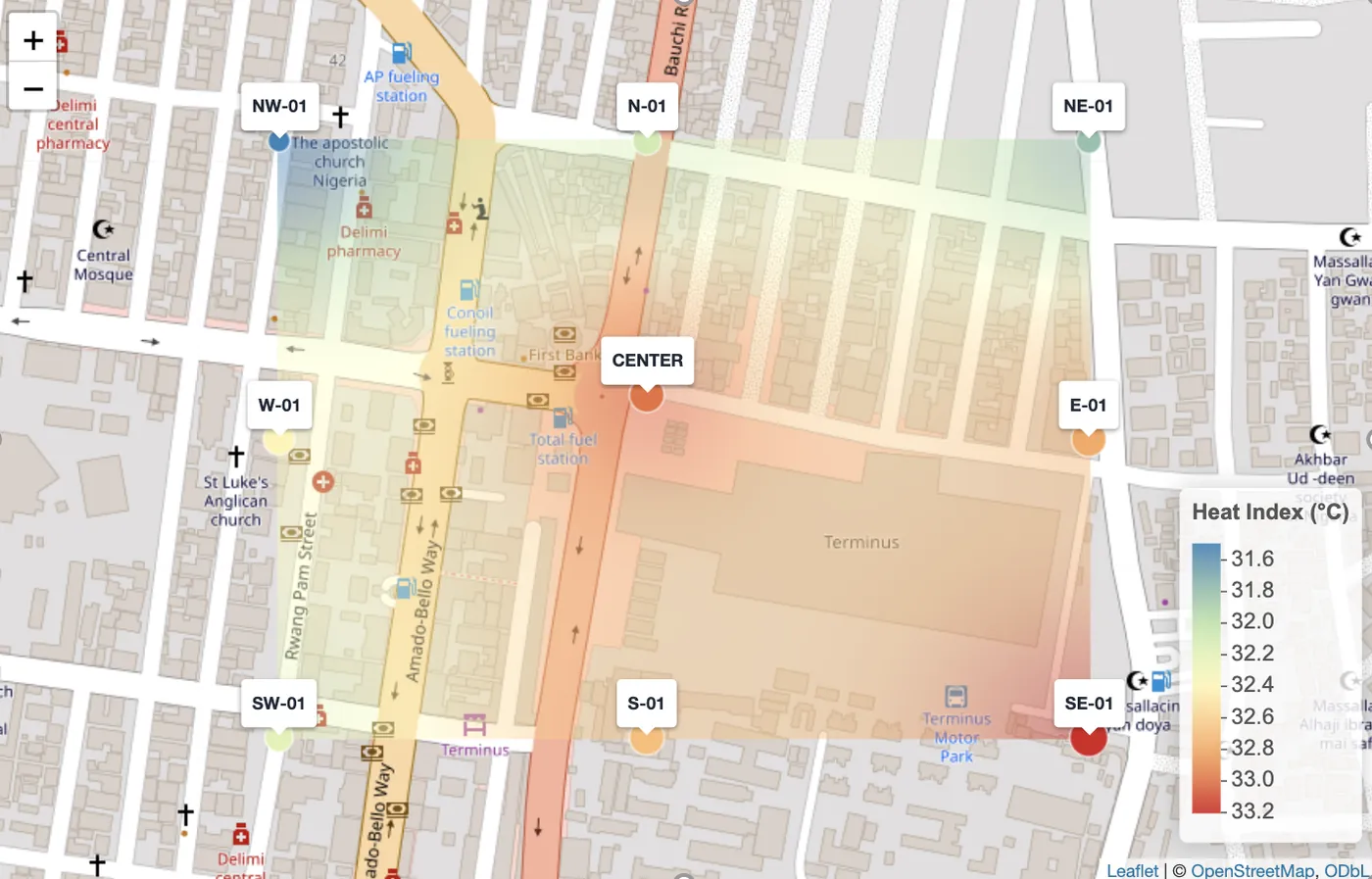
7:01 a.m. The numbers become a risk level. The risk engine doesn’t judge temperature alone. It combines temperature and humidity into a heat index, because hot and humid air is what makes heat dangerous: 34°C with high humidity can feel closer to the mid-40s. It also checks air quality against thresholds and adds time-based patterns, such as the fact that exposure peaks around midday. The result is one of four levels: Low, Moderate, High, or Dangerous. The heatmap above shows this scoring applied across locations.
I chose four levels on purpose. People make quick decisions, and one clear category is easier to act on than a table of readings. The thresholds are currently being calibrated against Nigerian climate conditions so the categories reflect local risk, not defaults built for other places.
7:02 a.m. The level becomes an instruction. A “High” or “Dangerous” score is useless on its own, so an AI layer turns it into advice:
Extreme heat risk today. Avoid outdoor activity between 12pm and 4pm.
or, for air quality:
Unhealthy air quality. Sensitive groups should remain indoors.
This layer is where most of my current effort goes. The goal is alerts that sound local and account for context, like work hours and school schedules, instead of reading like a generic weather bulletin.
7:03 a.m. The message reaches a phone. Alerts go out over WhatsApp, because that’s where people already are. For people on basic phones, SMS is the fallback, and schools and community partners get a simple dashboard. Nothing in the flow requires downloading an app. Making delivery reliable is the main engineering priority for the pilots, because an accurate alert that doesn’t arrive protects no one.
Where it stands
HeatSafe is a working prototype, not yet a deployed service, and it is backed by Bloomberg Philanthropies’ Youth Climate Action Fund. Built so far:
- system architecture and working prototypes
- an initial risk-scoring engine
- early alert message generation
- integration with environmental data sources
- designed WhatsApp and SMS delivery paths
What’s next
The next step is structured pilots in high-heat, high-density communities. The questions I want to answer are whether alerts change what people do and whether heat-risk awareness improves. To get there, I’m working on more reliable WhatsApp and SMS delivery, wider data coverage across Nigerian cities, sensors deployed in the field, and better local calibration of the risk and language layers. I’m seeking additional support to fund it.
Takeaway
A warning nobody can understand, receive, or act on isn’t a warning. Most of the work in HeatSafe isn’t measuring heat. It’s making sure the right message reaches the right person in time.
Related: Arrrc, an AI health companion that also turns complex information into a clear next step.