Overview
Money Autopsy is a personal finance web app designed around a simple idea:
Your bank statement knows what you did with your money. We help you understand why.
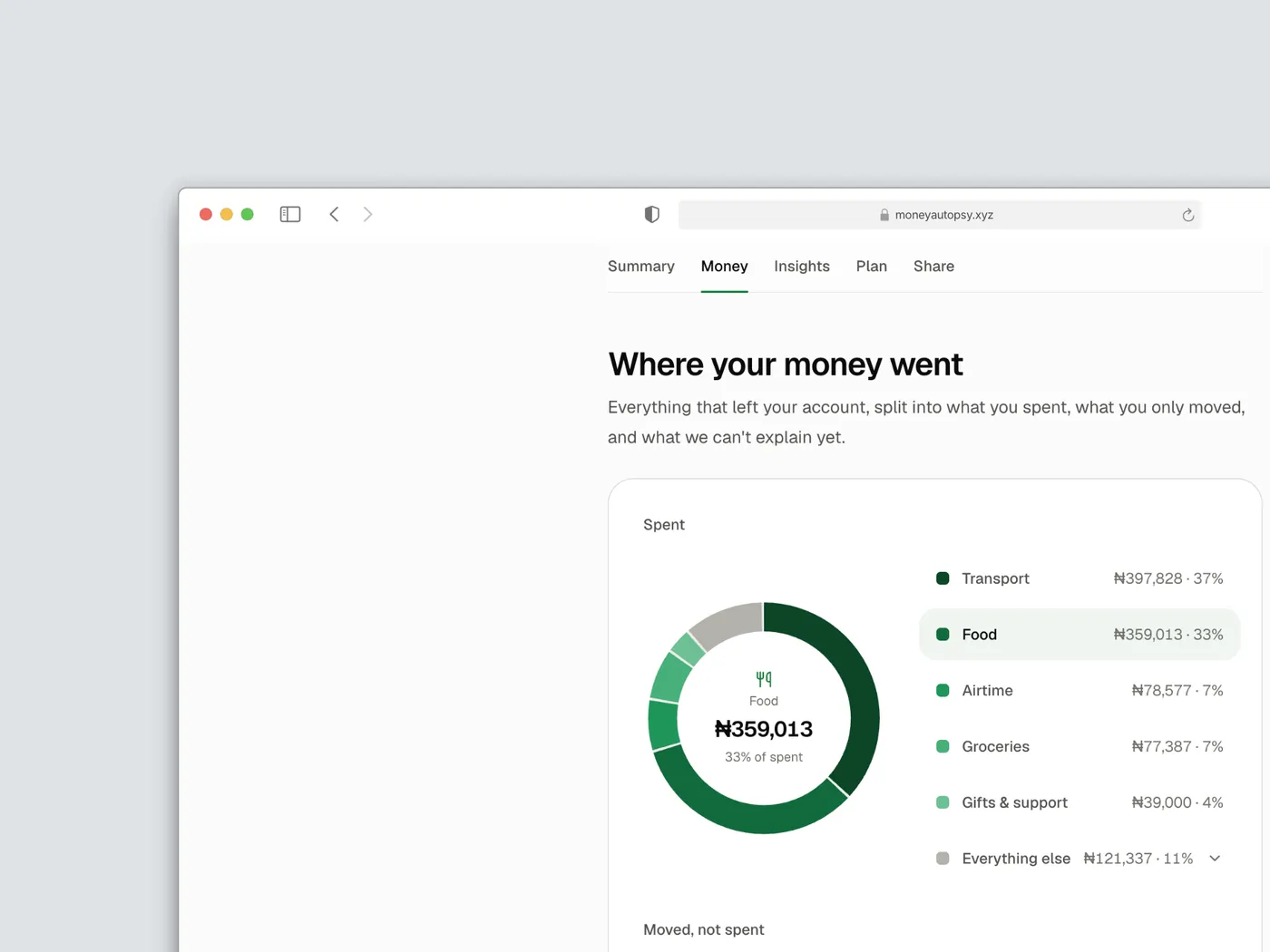
Instead of simply categorizing transactions, Money Autopsy analyzes a user’s financial behavior, identifies spending patterns and leakages, and turns them into practical recommendations for what to do next.
The problem
Most personal finance tools tell you where your money went.
That’s useful, but incomplete. A transaction category doesn’t tell you:
- why your food spending is unusually high
- whether a transfer was actually a purchase, gift, loan or reimbursement
- how much you’re losing to small recurring purchases
- whether your spending matches your lifestyle
- what behaviors are creating financial leakage
- what you could realistically change next month
This becomes even harder in Nigeria, where bank statements contain ambiguous transfers, personal accounts used by merchants, POS transactions, betting platforms, fintech services and informal payments that don’t fit neatly into conventional budgeting categories.
I wanted Money Autopsy to go beyond “here’s what you spent” and answer:
What is actually happening with your money?
The approach
The product combines three things.
01 — Understand the person
Before analyzing their statement, Money Autopsy learns about the user. The onboarding captures context such as:
- gender
- income sources
- primary income source
- living situation
- financial goals
- whether they regularly withdraw cash
- borrowing and lending habits
- family/social support
- spending behaviors
The goal isn’t to ask 30 questions. It’s to collect the small amount of context that makes the transaction data make sense.
02 — Understand the transactions
Users upload their bank statement as a PDF or CSV. The system extracts and normalizes the transactions before attempting to categorize them.
But categorization isn’t purely based on merchant names. A Nigerian bank statement might contain:
That could mean:
- food
- a gift
- a loan
- reimbursement
- a merchant using a personal account
- payment for a service
So the system combines transaction data + merchant intelligence + transaction patterns + user context to determine the most likely meaning.
03 — Turn the data into an autopsy
Once the transactions are understood, the system looks for patterns. Not just:
But:
The product looks for things such as:
- spending leaks
- unusual spending
- recurring expenses
- high-frequency purchases
- excessive data/airtime spending
- betting activity
- bank charges
- savings/investment transfers
- social/family transfers
- cash withdrawal patterns
- income patterns
- spending changes
- potential opportunities to save
Designing for Nigeria
One of the most interesting parts of the project was realizing that conventional transaction categorization doesn’t map cleanly onto Nigerian financial behavior.
Personal transfers aren’t always personal.
A transfer to another person’s account could be a gift, food payment, loan, reimbursement or merchant transaction.
POS isn’t automatically cash withdrawal.
A POS transaction shouldn’t automatically be interpreted as cash withdrawal because the statement often doesn’t provide enough information to make that distinction. Instead, Money Autopsy asks the user separately whether they regularly withdraw cash to keep on hand.
Fintechs create different signals.
Services such as:
- Moniepoint
- Paystack
- Cowrywise
- PiggyVest
can represent very different financial behaviors. A Moniepoint transaction may indicate a merchant payment. Cowrywise or PiggyVest may indicate savings or investment behavior. The system therefore uses transaction context instead of blindly mapping company names to spending categories.
Informal financial behavior matters.
Money moving between people can represent:
- gifts
- “billing”
- borrowing
- lending
- splitting expenses
- reimbursements
- family support
Money Autopsy treats these as distinct possibilities rather than forcing everything into “transfers.”
The paywall
The product is designed around a partial autopsy. Users get enough information to understand that the analysis is useful. Then the deeper findings are intentionally obscured. For example:
This creates a natural transition from curiosity to the paid report rather than putting the entire product behind a generic subscription wall.
From autopsy → action
The autopsy isn’t supposed to be the end. After identifying what happened, Money Autopsy creates a personalized Money Plan.
Instead of giving everyone a generic 50/30/20 budget, the system uses the user’s actual behavior to determine what could realistically change. For example:
Instead of “Stop eating out,” Money Autopsy might suggest:
Then show the potential impact:
with the appropriate framing that this is a scenario, not a guaranteed saving.
Safe to spend
One of the product’s key concepts is a safe-to-spend number. Instead of forcing users to constantly calculate whether they can afford something, Money Autopsy can translate their financial situation into something tangible:
The calculation considers:
- available money
- upcoming expenses
- expected income
- savings goals
- recurring payments
- remaining days
- existing spending patterns
The arithmetic is deterministic rather than delegated to the AI.
30-day reset
The final output is intentionally simple. Instead of giving users 20 financial goals:
Your 30-Day Reset
- Move ₦80k to savings when your next income arrives.
- Keep food below ₦100k.
- Cancel two subscriptions you don’t use.
- Keep ₦25k untouched as a buffer.
The philosophy is:
You don’t need to become a different person. You just need to change a few things.
The AI architecture
The LLM isn’t responsible for doing the financial mathematics. That distinction was important.
Deterministic code handles:
- transaction totals
- category totals
- income calculations
- spending calculations
- savings calculations
- percentages
- annualized scenarios
- safe-to-spend calculations
The LLM handles:
- interpreting financial behavior
- identifying meaningful patterns
- explaining findings
- generating personalized recommendations
- creating spending rules
- generating the 30-day reset
- adapting recommendations to the user’s goals
This keeps the system flexible without allowing the AI to invent financial numbers.
Product philosophy
Money Autopsy isn’t designed to tell people:
Stop spending money.
It’s designed to tell them:
Spend your money on purpose.
Someone might genuinely value eating out. Someone might regularly support their family. Someone might spend heavily on data because they work online. Someone might have irregular freelance income.
The goal isn’t to judge those behaviors. The goal is to understand them well enough to help the user make better decisions.
Outcome
Money Autopsy became an exploration into what happens when AI is used as an interpreter of financial behavior rather than just a transaction categorizer.
The product takes an otherwise overwhelming bank statement and turns it into:
raw transactions → financial context → behavioral patterns → financial diagnosis → actionable plan
The core question isn’t:
Where did my money go?
It’s:
What does the way I spend money say about my financial life, and what can I actually change?
Related: Arrrc, another AI product, where the question of what the AI should and should not decide shapes the design.